
21 November 2026 Tamilnadu: The Cauvery Water Dispute has taken another significant turn after the Supreme Court of India dismissed two applications filed by Tamil Nadu seeking directions to Karnataka to release approximately 11 TMC of additional Cauvery water. The decision was delivered on Friday, November 20, 2026, by a bench comprising Justice Vikram Nath and Justice Aparesh Singh.
The applications were connected to Tamil Nadu’s allegation that Karnataka had failed to release its stipulated share of river water. Karnataka opposed the demand, referring to deficient rainfall and drought conditions. Although the latest decision is a setback for Tamil Nadu’s immediate demand, it does not bring the broader inter-state water-sharing dispute to an end.
Contents
- What Did the Supreme Court Rule in the Cauvery Water Dispute?
- Why Did Tamil Nadu Demand 11 TMC of Cauvery Water?
- What Is the 11.719 TMC Shortfall at Billigundulu?
- Why Did Karnataka Oppose Tamil Nadu’s Water Demand?
- What Are the Roles of CWMA and CWRC in the Cauvery Water Dispute?
- What Is the Legal Background of the Cauvery Water Dispute?
- What Happens Next After the Supreme Court’s Decision?
- Key Facts at a Glance
- Frequently Asked Questions (FAQs)
- 1. Why did the Supreme Court dismiss Tamil Nadu’s Cauvery water applications?
- 2. How much Cauvery water shortfall did Tamil Nadu claim?
- 3. Why did Karnataka oppose Tamil Nadu’s demand for 11 TMC?
What Did the Supreme Court Rule in the Cauvery Water Dispute?
On November 20, the Supreme Court dismissed two applications submitted by the Tamil Nadu government seeking an additional release of approximately 11 thousand million cubic feet (TMC) of Cauvery water from Karnataka. The matter was heard by a bench of Justice Vikram Nath and Justice Aparesh Singh. The decision followed arguments from both states over the alleged shortfall and the implementation of existing water-sharing directions.
The dismissal means Tamil Nadu did not obtain the specific directions it had requested through these two applications. The Supreme Court of India had reserved its decision on the applications on October 12. The latest ruling should be understood within the scope of those applications rather than as a final settlement of every issue connected with the Cauvery Water Dispute.
Why Did Tamil Nadu Demand 11 TMC of Cauvery Water?
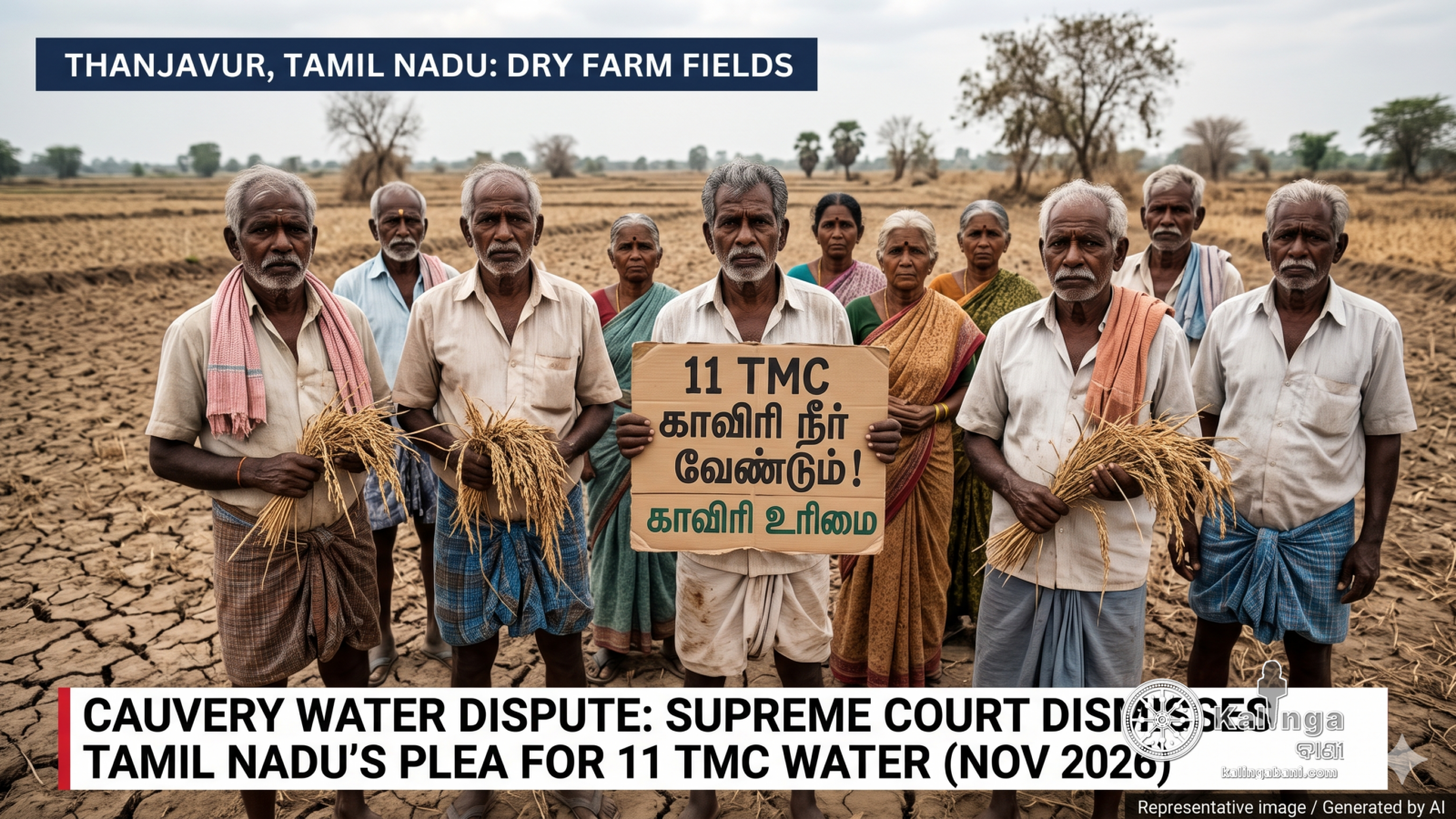
Tamil Nadu approached the court alleging that Karnataka had not released the required quantity of Cauvery water despite the state’s claim that sufficient water was available in its reservoirs. Tamil Nadu sought directions for the release of an alleged backlog of around 11 TMC as of October 7, 2026. The state argued that the pending quantity was necessary to meet its water requirements.
During the proceedings, Tamil Nadu’s counsel sought the release of water at a rate of 1.3 TMC per day for 10 days to make good the claimed shortfall. The state’s position was that it was not receiving its stipulated share under the existing arrangement. The demand became a central issue in the latest round of the Cauvery Water Dispute before the Supreme Court.
What Is the 11.719 TMC Shortfall at Billigundulu?
One important detail in the case concerns Billigundulu, a key water-measuring station located near the Karnataka-Tamil Nadu border. Tamil Nadu claimed that the shortfall recorded at this measuring point had reached 11.719 TMC up to October 6, 2026. This figure represents the shortfall alleged by Tamil Nadu and should not be confused with the approximately 11 TMC release sought in its applications.
Billigundulu is important because river-water flows at this point help assess the quantity of water reaching Tamil Nadu from Karnataka. The Central Water Commission has documented the Cauvery river system and its measurement arrangements. Disagreements over recorded flows and the interpretation of release obligations have repeatedly influenced the Cauvery Water Dispute.
Why Did Karnataka Oppose Tamil Nadu’s Water Demand?
Karnataka opposed Tamil Nadu’s request, arguing that the state was facing deficient rainfall and drought-like conditions in several areas. Its position was that releasing the additional quantity demanded by Tamil Nadu would be difficult during a rain-deficit period. Karnataka also disputed the allegations that it had deliberately failed to follow the established water-release arrangement.
Karnataka maintained that it was complying with directions issued by the Cauvery Water Management Authority. The state’s argument highlighted the challenge of balancing water requirements between the two states when rainfall and reservoir inflows are below expectations. These competing positions formed an important part of the latest proceedings in the Cauvery Water Dispute.
What Are the Roles of CWMA and CWRC in the Cauvery Water Dispute?
The Cauvery Water Management Authority (CWMA) and the Cauvery Water Regulation Committee (CWRC) are part of the institutional framework established to oversee implementation of the Cauvery water-sharing arrangement. The Central Government notified the Cauvery Water Management Scheme on June 1, 2018. The framework followed the Supreme Court’s 2018 judgment and the earlier tribunal process.
The CWMA is responsible for supervising the implementation of the water-sharing framework, while the CWRC supports the regulatory and monitoring process. Their work is important for assessing water availability, releases and compliance with the prescribed arrangements. The Ministry of Jal Shakti’s official document outlines the management scheme and the institutional history behind the current system.
What Is the Legal Background of the Cauvery Water Dispute?
The Cauvery water-sharing dispute has a long legal history involving Karnataka, Tamil Nadu and other states in the river basin. The Cauvery Water Disputes Tribunal was constituted in 1990 to examine the dispute and determine water-sharing arrangements. After the tribunal submitted its final report in 2007, the matter continued through legal proceedings before the Supreme Court.
On February 16, 2018, the Supreme Court delivered a major judgment modifying aspects of the tribunal’s award and addressing the allocation of Cauvery water among the concerned states. The judgment became an important foundation for the subsequent management scheme notified in June 2018. The 2018 Supreme Court judgment remains a key legal reference in the continuing Cauvery Water Dispute.
What Happens Next After the Supreme Court’s Decision?
The immediate outcome is that Tamil Nadu’s two applications seeking directions for the release of approximately 11 TMC of additional water have been dismissed. The decision does not automatically remove the existing water-sharing responsibilities or eliminate the role of the CWMA and CWRC. Both states remain subject to the applicable legal and administrative framework governing the river’s water distribution.
For Tamil Nadu, the ruling is a setback to its latest attempt to secure the claimed backlog through these applications. Karnataka, meanwhile, has maintained that it is following the management authority’s directions while dealing with rainfall-related difficulties. Future developments will depend on water availability, official assessments and any further legal or administrative proceedings. The Cauvery Water Dispute therefore remains an important issue for both states, particularly for farmers and communities dependent on the river.
Source: Akashvani News, NDTV/PTI, LiveLaw, New Indian Express and official documents of the Supreme Court of India and Ministry of Jal Shakti.
The Supreme Court dismissed two applications filed by Tamil Nadu seeking directions for Karnataka to release approximately 11 TMC of Cauvery water. The decision was delivered on 20 November 2026.
TAMIL NADU’S DEMAND
- Release of approximately 11 TMC of Cauvery water.
- Claimed backlog as of 7 October 2026.
- Requested release rate: 1.3 TMC per day for 10 days
- Separately claimed a shortfall of 11.719 TMC at Billigundulu up to 6 October 2026.
KARNATAKA’S RESPONSE
Karnataka opposed the additional water demand, citing deficient rainfall and drought conditions. It maintained that it was complying with the directions issued by the Cauvery Water Management Authority.
WHY THIS MATTERS
The dismissal concerns Tamil Nadu’s two applications seeking additional water release. It does not mean that the wider Cauvery water-sharing dispute or the existing water-management framework has been permanently resolved.
Key Facts at a Glance
| Key Detail | Verified Information |
|---|---|
| Decision Date | 20 November 2026 |
| Court | Supreme Court of India |
| Bench | Justice Vikram Nath and Justice Aparesh Singh |
| Applications Dismissed | Two applications filed by Tamil Nadu |
| Water Sought | Approximately 11 TMC |
| Claimed Shortfall | 11.719 TMC at Billigundulu up to 6 October 2026 |
| Tamil Nadu’s Requested Release Rate | 1.3 TMC per day for 10 days |
| Karnataka’s Objection | Deficient rainfall and drought conditions |
Source: Akashvani News, NDTV/PTI, LiveLaw and New Indian Express. Updated: 21 November 2026.
Frequently Asked Questions (FAQs)
1. Why did the Supreme Court dismiss Tamil Nadu’s Cauvery water applications?
The Supreme Court dismissed two applications filed by Tamil Nadu seeking directions to Karnataka to release approximately 11 TMC of additional Cauvery water. The bench delivered its decision on November 20, 2026.
2. How much Cauvery water shortfall did Tamil Nadu claim?
Tamil Nadu claimed a shortfall of 11.719 TMC at the Billigundulu measuring point up to October 6, 2026. It separately sought the release of approximately 11 TMC through its two applications.
3. Why did Karnataka oppose Tamil Nadu’s demand for 11 TMC?
Karnataka opposed the demand, citing deficient rainfall and drought conditions in parts of the state. It also maintained that it was complying with the directions issued by the Cauvery Water Management Authority.



Leave a Reply